What Is a Faceoff in Ice Hockey?
A faceoff is the method used to restart play in ice hockey. Learn where faceoffs happen, which players take them, and how teams try to win possession.
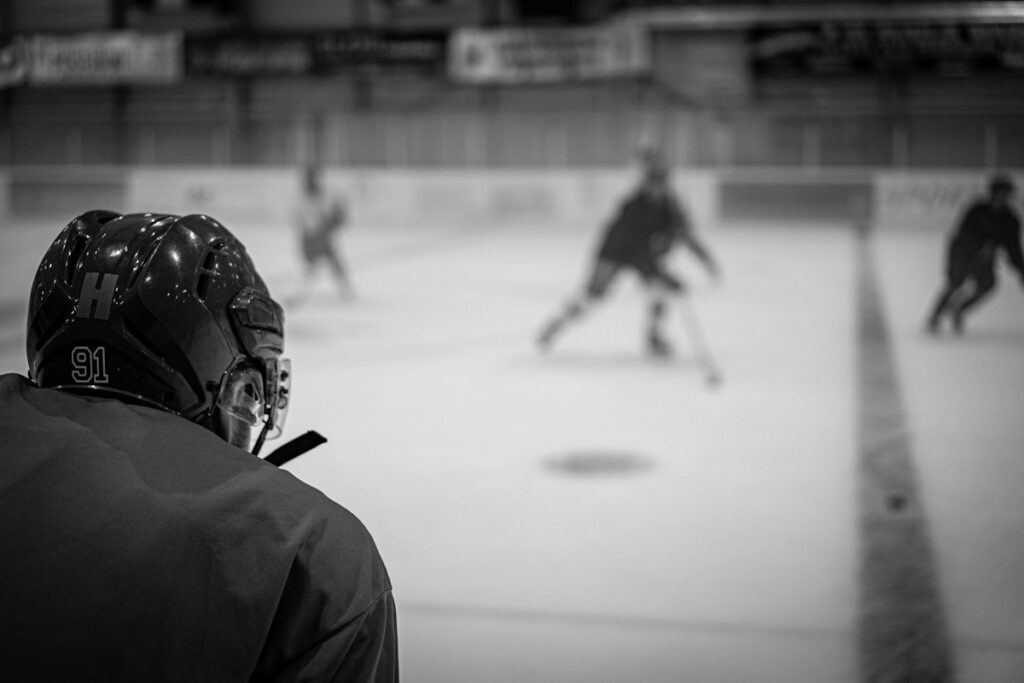
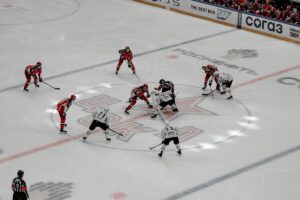
A faceoff in ice hockey is the restart used after play has stopped. An official drops the puck between two opposing players, usually the centers, and the players compete to direct it to a teammate. The team that controls the puck after the drop can begin an attack, clear its defensive zone, or establish possession in the offensive zone.
Faceoffs take place at marked circles on the ice. Their location depends on why play stopped and which team is being awarded the restart. Understanding the faceoff rules helps explain how hockey teams manage possession and create scoring chances.
How an ice hockey faceoff works
Before the puck is dropped, the two centers line up opposite each other inside the faceoff circle. Their sticks are placed on the ice, with the blade positioned on their side of the faceoff spot. The other skaters take positions around the circle or along the nearby hash marks, depending on the faceoff location and the rules being used.
The official dropping the puck makes sure the players are properly positioned before releasing it. Once the puck hits the ice, both centers use their sticks, body position, and timing to win it or tie it up for a teammate. A center does not always need to pull the puck directly backward. They may push it forward, angle it toward the boards, or block an opponent while a teammate collects it.
A faceoff can last only a fraction of a second, but the result often depends on preparation. Centers study an opponent’s usual hand position and stick movement, while wingers and defensemen anticipate where the puck is likely to go. Teams also use set plays, such as sending the puck back to a defenseman for an immediate shot.
Where are faceoffs taken?
Ice hockey has nine standard faceoff spots: one at center ice, two in each team’s defensive zone, two in each team’s attacking zone, and two in the neutral zone. The exact restart location is determined by the reason for the stoppage and the applicable league rules.
The center-ice faceoff starts each period and follows a goal. Faceoffs in the neutral zone are common after certain stoppages near the blue lines. An attacking-zone faceoff gives the offensive team a chance to regain the puck close to the opponent’s net, while a defensive-zone faceoff can put pressure on a team that is trying to clear the puck.
Faceoff location can also depend on events such as an offside call, icing, the puck leaving the playing surface, or a penalty. Rules differ slightly between competitions, so a professional league, international tournament, and youth league may place some restarts differently.
Who takes the faceoff?
Centers usually take faceoffs because they are positioned in the middle of the line and are often responsible for directing play. However, any eligible player may take the draw if a team changes its lineup or replaces a center. A winger or another skater may step in when a center is removed from the circle for a violation.
Players use either a forehand or backhand setup. The choice affects the angle at which the stick can contact the puck and the direction of a planned play. A strong faceoff player also needs balance, quick reactions, and the ability to read the opponent rather than relying only on physical strength.
Faceoff violations and puck possession
Officials can remove a player from the faceoff if that player or a teammate is improperly positioned, moves too early, or delays the procedure. The opposing team’s designated player then takes the draw. Repeated violations may lead to further penalties under the rules of the competition.
Players outside the circle must remain onside and avoid gaining an unfair advantage before the puck is dropped. They may move immediately after the drop, but entering too early or crossing a restricted line can cause the faceoff to be stopped and retaken.
A faceoff win does not guarantee possession for long. The puck may be tied up under a player’s stick, kicked loose, or recovered by an opponent. For that reason, coaches evaluate faceoff success together with support from wingers, puck recovery, and the team’s ability to make the next play.
Why faceoffs matter in a hockey game
Winning a faceoff in the offensive zone can produce a quick shot before the defending team sets up. In the defensive zone, a clean win may allow a team to move the puck away from danger. A neutral-zone win can help a team enter the attacking zone with speed.
Faceoffs are especially valuable late in a close game. A team protecting a narrow lead may use a draw to regain the puck and clear it safely, while a trailing team may try to win an attacking-zone faceoff and keep pressure near the net. The importance of the restart therefore depends on both its location and the game situation.
Frequently asked questions
What is the purpose of a faceoff in hockey?
The purpose of a faceoff is to restart play fairly after a stoppage. Two opposing players compete for a puck dropped by an official at a designated spot.
Does the center have to win the puck backward?
No. A center can direct the puck in any legal direction. The best choice depends on the team’s positioning and the play it wants to make.
How many faceoff circles are on a hockey rink?
Standard hockey rinks have nine faceoff spots, including the center-ice spot and the circles in the attacking, defensive, and neutral zones.