What Is Shooting Percentage in Ice Hockey?
Ice hockey shooting percentage shows how often a player or team turns shots on goal into goals. Learn the formula, how to interpret it, and why context matters.
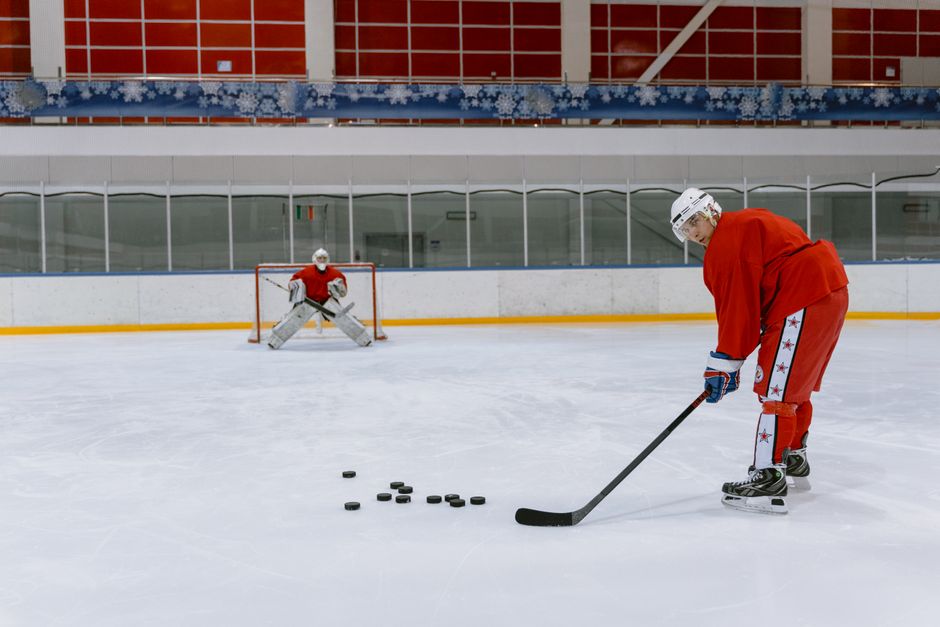
A player can fire the puck 100 times and score 15 goals, while another scores 10 goals from only 40 shots. Goals alone do not show the difference in efficiency. That is where shooting percentage in ice hockey becomes useful.
Shooting percentage measures the share of a player’s shots on goal that become goals. It helps compare finishing efficiency, but it does not measure every part of a player’s offensive value or guarantee what will happen in the future.
How to calculate shooting percentage in hockey
The shooting percentage formula in hockey is:
Shooting percentage = goals ÷ shots on goal × 100
For example, a forward with 18 goals on 120 shots has a shooting percentage of 15%:
18 ÷ 120 × 100 = 15%
The calculation uses shots on goal, not every attempted shot. A shot that misses the net or is blocked before reaching the goaltender is normally recorded separately and does not enter the standard player shooting percentage calculation.
What a hockey shooting percentage tells you
A high shooting percentage generally means a player has converted a large share of their shots into goals. That can reflect accurate finishing, strong shot selection, dangerous positioning near the crease, effective power-play opportunities, or excellent passing from teammates.
A low percentage may indicate poor finishing, difficult shot locations, limited scoring chances, or an unusually unlucky stretch. It does not automatically mean the player is ineffective. A defenseman who takes many long-range shots may have a lower percentage than a forward who regularly shoots from close range, even if both contribute significantly.
For teams, the same calculation produces team shooting percentage: total goals divided by total shots on goal. Analysts may also use the term shot conversion rate for this idea. Team shooting percentage can reveal how efficiently a club finishes its chances, although it is best read alongside shot quality, expected goals, power-play performance, and possession metrics.
Why the number needs context
Shooting percentage is easy to calculate but easy to overinterpret. The main problem is sample size. A player who scores four goals on 12 shots has a 33.3% shooting percentage, but that figure may fall quickly over a longer schedule. One fortunate rebound or deflection can have a major effect when the number of shots is small.
Shot location also matters. A player taking shots from the slot is working with different chances than one attempting point shots through traffic. A high percentage may partly reflect a role built around tap-ins and rebounds, while a lower percentage may belong to a player trusted to shoot from distance when a passing lane is unavailable.
Situation matters as well. Power-play shots, empty-net goals, breakaways, and even-strength attempts do not carry the same conditions. Comparing an NHL shooting percentage across players is more informative when their ice time, position, role, and types of opportunities are similar.
How it differs from related hockey statistics
Goals: The raw number of goals shows production, while shooting percentage shows how efficiently shots became goals.
Shots on goal: This is the volume behind the calculation. A player needs both opportunity and efficiency to produce consistently.
Shot attempts: Attempts include shots that miss the net and shots blocked by opponents. They are useful for measuring offensive involvement but are not the denominator in the standard shooting percentage formula.
Save percentage: Goaltender save percentage measures the share of shots on goal a goalie stops. Shooting percentage and save percentage describe opposite sides of the same basic scoring event, but they evaluate different players.
Expected goals: Expected-goals models estimate the quality of chances. They can help show whether a high or low shooting percentage is supported by the types of shots a player takes.
Is a high shooting percentage always better?
Higher is usually better over a meaningful sample, but the number should not be judged in isolation. A player with a 20% shooting percentage on 50 shots may have scored efficiently, yet a player with 14% on 250 shots may have created far more goals and offensive pressure.
Season-to-season changes can also be misleading. A sudden increase may come from more time near the net, improved teammates, favorable rebounds, or simple variance. A falling percentage may not signal a serious decline if the player continues to create high-quality chances.
Frequently asked questions
What is a good shooting percentage in ice hockey?
There is no single ideal number for every player. Position, role, shot location, league, and sample size all matter. Comparisons are most useful among players with similar responsibilities and opportunities.
Do missed shots count in shooting percentage?
No. Standard player shooting percentage uses goals divided by shots on goal. Missed and blocked shots are excluded from that calculation.
Can shooting percentage predict future goals?
It can provide useful context, but short-term results often include luck. Longer samples and supporting measures such as shot volume and expected goals offer a more reliable picture.