What Is Embellishment in Ice Hockey? Meaning and Penalty
Embellishment in ice hockey is an exaggerated reaction intended to make contact look more serious and draw a penalty. Learn how referees identify it, how it differs from diving, and what happens when it is called.
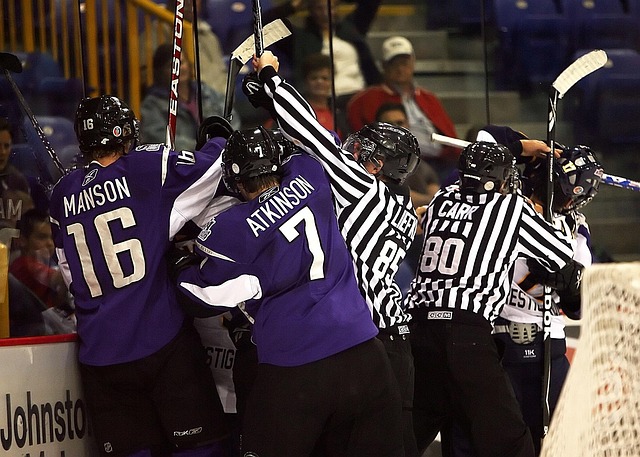
Embellishment in ice hockey is an exaggerated fall or reaction intended to make a referee believe that an opponent committed a more serious foul. A player may have been touched or hooked, but the reaction is judged to be excessive or designed to influence the call.
In most rule systems, embellishment is penalized as an attempt to deceive the officials. The player does not have to invent contact completely; exaggerating legitimate contact can still meet the definition.
How referees identify embellishment
Officials consider the whole sequence rather than judging only how far a player falls. They may look at the amount and direction of the contact, the player’s skating position, the movement of the stick or arm, and whether the reaction matches the force of the infraction.
For example, a player who is lightly held but suddenly throws both legs forward may be called for embellishment. A skater who loses balance because a defender’s stick genuinely hooks a skate is less likely to receive that call, even if the fall looks dramatic.
Referees also use video review, positioning, and repeated behavior as context where the competition’s rules allow it. A theatrical reaction alone is not proof: players can fall hard after minor contact because they are moving quickly, battling for position, or already off balance.
Embellishment versus diving
The terms embellishment and diving are often used interchangeably, but rule wording can differ between leagues. Embellishment usually focuses on exaggerating the effect of real contact. Diving generally describes creating the appearance of a foul when the contact is minimal or absent.
Some hockey rulebooks combine both ideas under one penalty, while others use separate descriptions. That is why the exact call may appear as “embellishment,” “diving,” or “diving or embellishment” on a scoresheet. The practical meaning is similar: the official believes the player tried to manufacture or exaggerate a penalty.
What penalty does embellishment carry?
In leagues that follow the standard hockey approach, embellishment is normally a minor penalty, which sends the offending player to the penalty box for two minutes. The original infraction may also be called against the opponent. In that situation, both players can be penalized rather than the embellishment canceling the underlying foul.
The exact treatment depends on the league and competition. Youth, amateur, international, and professional rulebooks can differ in penalty wording, reporting requirements, and supplementary discipline. A player who repeatedly embellishes may also attract fines or further league attention under competition-specific policies.
Why a player might still be penalized after being fouled
A real foul does not automatically protect a player from an embellishment call. Officials are expected to penalize both the illegal action and an exaggerated response when both affected the play. This prevents players from turning minor contact into a manufactured scoring chance or power play.
There are difficult edge cases. A stick may catch a player’s skate while the player is turning, or a defender may make legal body contact that causes an unexpected fall. The player’s balance, speed, and position can make the reaction look disproportionate even without an attempt to deceive. Those situations are judgment calls, which is why embellishment penalties can be controversial.
How players can avoid an embellishment call
Players should continue skating when they can, keep their arms and legs natural, and avoid adding movement after contact has already caused them to lose balance. They can still protect themselves and report a genuine infraction, but dramatic gestures or a delayed fall can make the play look staged.
For coaches and viewers trying to judge a disputed call, slow-motion video should be checked for the initial contact rather than only the final fall. The most useful questions are whether an opponent’s action restricted the player’s movement, whether the player could reasonably stay upright, and whether the reaction began before or after the contact.
Why the rule matters
The embellishment rule protects the fairness of penalty decisions. Without it, a player could gain a power play by exaggerating ordinary battles along the boards, stick contact near the hands, or minor interference while skating. The rule does not require players to absorb dangerous contact silently; it asks them to avoid deliberately overstating what happened.
In short, the meaning of embellishment in hockey is an exaggerated or manufactured reaction intended to draw a call. It can be penalized even when some contact occurred, and the applicable league rule determines whether the call is labeled embellishment, diving, or both.